Dental Implant Instruments

Manual Bone-Crushing Pliers

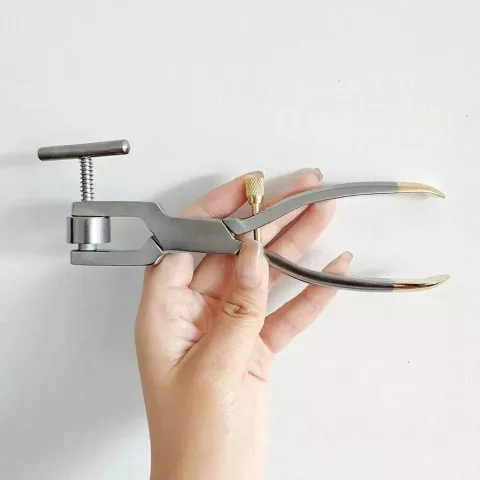
Hand-operated bone-crushing pliers with a round chamber and a T-shaped adjustment screw, for crushing pieces of harvested bone into particles for grafting.

Product code
DIS-IMP-CRUSH-PLIER
Size
Confirmed in your quotation
MOQ
confirmed with your quote

Courier delivery. We ship through DHL, FedEx or another available courier, depending on your destination. We confirm the courier, shipping cost and estimated delivery time with your order. Shipping details

About Manual Bone-Crushing Pliers

Bone removed during surgery, for example while preparing an implant site, can be reused as graft material from the patient's own bone. It first needs to be broken into small particles. Bone-crushing pliers do this by hand: the bone is placed in the round chamber and the handles are squeezed to crush it.

How it is made

  • Plier-style handles for hand pressure.
  • Round crushing chamber.
  • T-shaped adjustment screw.

Crusher, mill or scraper?

  • Bone-crushing pliers (this instrument): crush bone pieces by squeezing.
  • Bone mill: grinds bone by turning. See our manual rotary bone mill.
  • Bone scraper: harvests thin shavings directly from the bone surface. See our curved bone scrapers.

If you need to know the chamber size, ask and we confirm the dimensions in your quotation.

Ordering

  • Sold as one instrument.
  • Evaluation samples are available.

Care

Take out all bone from the chamber straight after use and check the crushing surfaces. Follow the supplied processing instructions and your facility's validated protocol.

To place the particles, see our bone graft syringe set.
Have experience with Manual Bone-Crushing Pliers?Share verified buyer or evaluator feedback. It takes about a minute.

Manual Bone-Crushing Pliers Questions

What is the purpose of manual bone-crushing pliers?

They belong to the hand-operated bone-processing instrument class used to reduce collected bone into smaller pieces for graft preparation. This plier form has a round well and opposed textured working faces, and its task concerns collected material, not harvesting at a bone surface.

What do the round well and opposed working faces describe?

The round well is the containing space at the head, and the opposing textured faces are the working surfaces that act on the collected material. Well dimensions and working-face dimensions describe separate parts of the assembly, not a final-particle specification.

Are crusher, morselizer and bone mill always different instrument types?

No, not always. The names overlap across manufacturers: some manufacturers call a hinged, two-face instrument a bone mill, while others use crusher or morselizer. The construction and the full product reference are more specific than the class name alone.

How does this plier form differ from a cylindrical rotary bone mill?

This form uses plier handles, a round head and opposed working faces, while the separate cylindrical rotary mill is identified by a housing and hand-powered rotary construction. Compare the actual mechanism instead of assuming every plier only squeezes or every product called a mill rotates.

Which specifications distinguish bone-crushing capacity from particle output?

Well diameter and depth describe the containing space, and working-face dimensions describe the processing surfaces. Capacity and final-particle output answer different questions and need their own specifications, so do not treat a chamber or plate dimension as a particle size.

WhatsApp