
Dental Instruments Manufacturer in Sialkot, Pakistan
See how reusable dental hand instruments move from raw stainless steel through forming, finishing, inspection, marking, and export packing.
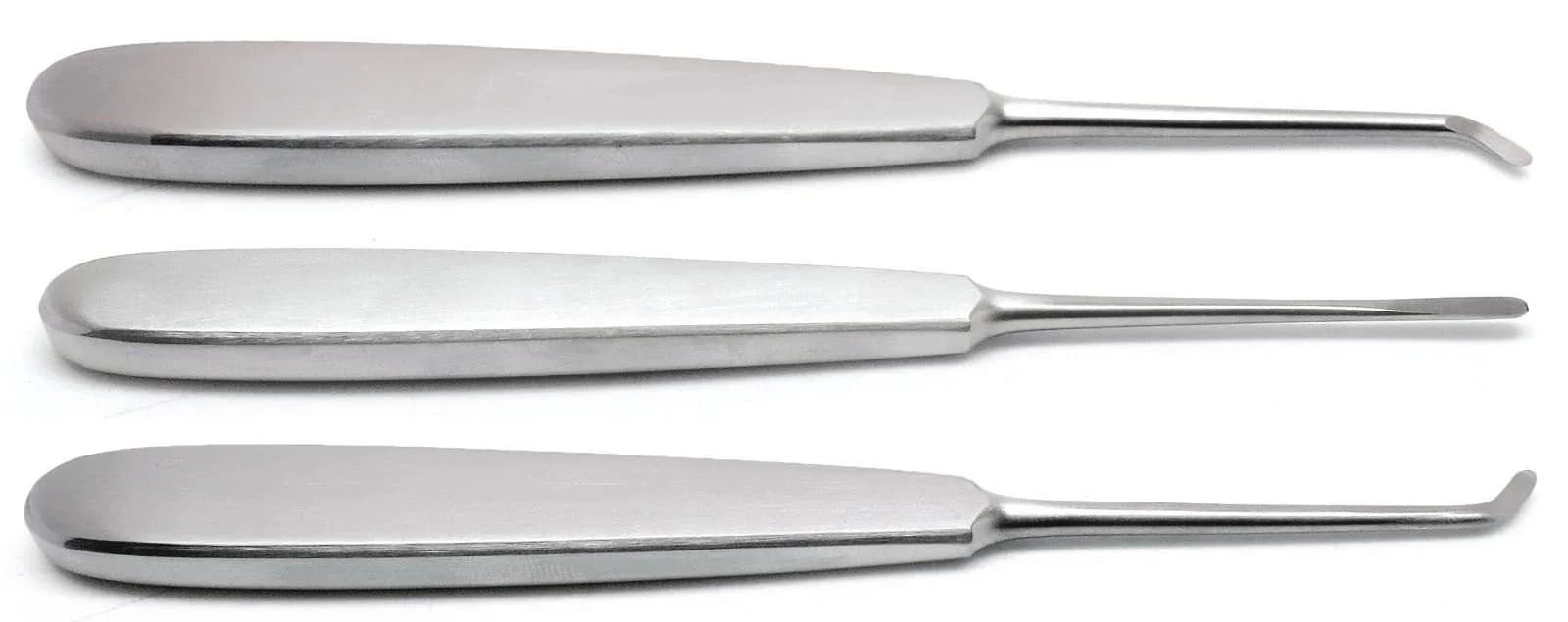
Dental Instruments Supplier is a direct dental instruments manufacturer based in Sialkot, Pakistan. Our workshop produces reusable dental hand instruments through a multi-stage process that transforms raw stainless steel into precision clinical tools.
We manufacture for dental clinics, distributors, schools, laboratories, and private-label buyers. Standard catalog patterns and custom programs follow the same core workflow: material selection, forming, heat treatment, grinding, finishing, assembly, inspection, marking, and export packing.
Dental Hand Instruments We Manufacture
Our catalog is organized by clinical procedure so buyers can source individual patterns, complete sets, or mixed-category orders without creating a separate supply relationship for every instrument family.
Examination and Treatment
Source diagnostic instruments, periodontal instruments, restorative instruments, and orthodontic hand instruments by pattern or set.
Extraction and Oral Surgery
Compare dental extraction forceps, dental elevators, and dental surgical instruments for extraction, flap, bone-management, and suturing setups.
Bulk, OEM, and Private Label
Use our wholesale dental instruments program for bulk or mixed-category orders, or review OEM and private-label manufacturing for marking and branded packaging.
Our 8-Step Manufacturing Process
Raw Material Selection
We source AISI 420 stainless steel from trusted suppliers in Sialkot. Each batch comes with material certificates verifying chemical composition — primarily Chromium 12–14% for corrosion resistance.
Forging
Steel bars are heated and forged using drop hammers. Forging compresses the metal grain structure, making instruments stronger than cast alternatives. Each instrument typically requires 2–3 forging operations.
Trimming & Shaping
Forged blanks are trimmed and shaped using grinding machines. Jaw profiles, serrations, and functional surfaces are cut to precise specifications.
Heat Treatment
Instruments are heat-treated to achieve the right hardness — typically HRC 40–50 for forceps and HRC 50–55 for cutting edges. This step determines the instrument's durability and corrosion resistance.
Grinding & Finishing
Belt grinders shape the final profiles. Instruments receive either satin finish (reduces glare) or mirror polish. Cutting edges are sharpened to the appropriate blade angle.
Assembly
Two-part instruments like forceps and scissors are assembled with box joints or screw joints. Joint tension is calibrated and tested for smooth operation.
Quality Inspection
Each instrument is inspected for dimensional accuracy, hardness, joint function, surface quality, and visual defects. Instruments that don't pass are rejected.
Marking & Packaging
Instruments are laser-marked with identification numbers, then ultrasonically cleaned and packaged in individual pouches or foam-lined boxes for shipping.
Export Supply for 41 Named Markets
The United States and United Kingdom are our primary markets, while buyers across Europe, the Americas, Asia-Pacific, the Middle East, Africa, and Russia can also request destination-specific quotations. Every route is confirmed against the exact pattern, material and finish, documentation, order quantity, freight, and lead-time requirements.
For United States Buyers
Send the product names or reference patterns, quantities, destination ZIP code, preferred finish, and whether the order is for direct clinical use, distribution, or private label. We will confirm current pricing, sample options, production scope, shipping, and the documentation available for that order.
For United Kingdom Buyers
Include the instrument list, quantities, delivery postcode, finish, branding needs, and any procurement or conformity documents your organization requires. We will confirm what can be supplied before samples or production are approved.
For Other Served Markets
Provide your delivery country, catalog references, drawings or sample instruments, packaging artwork, and target quantities. We will confirm the available route, documents, product scope, and repeat-order specifications before quoting.
Questions About Sourcing From Pakistan
What does the manufacturing overview tell me about a proposed instrument?
The overview describes the stages of producing and finishing hand instruments in our Sialkot workshop: material selection, forming, heat treatment where required, grinding, finishing, inspection, marking and export packing, and we confirm the workflow for your range in the quotation. For a purchase, identify which stages apply to the selected pattern and what specification governs the finished item, because a general workflow does not establish a particular machine, material grade, heat-treatment value or production method for every instrument in our range.
How can I check which operations the supplier actually performs?
List the operations that matter to the order and ask who performs and controls each one, including any finishing, assembly or inspection relevant to the item. Request supporting records or a review appropriate to those operations. Keep production responsibility separate from the name on the brand, invoice or website, because those labels alone do not document an operation.
Should I specify one steel grade for every part of an instrument?
No. We supply stainless-steel instruments and component-specific materials, and the material and applicable grade are identified for the selected SKU; one steel grade does not apply to every instrument or kit component. Specify the components and properties your purchase requires and compare them with the item documentation, because a working end, handle, joint or insert may need a separate description. If an exact grade is a purchasing requirement, state it for the relevant component and request evidence covering that component.
What should be agreed before an inspection or sample approval?
Record the selected reference, dimensions or other required characteristics, the agreed comparison method and who will review the result. A reference sample can help document what was approved, but the decision should identify the configuration rather than simply say that it looks acceptable. Keep changes and exceptions visible so a later order can be compared with the same approval basis.
Does adding a logo require the same review as changing the working end?
No. A logo or packaging request concerns an existing configuration and its presentation, while a changed working end affects the instrument specification itself. Describe the change and keep the original reference so the inquiry addresses the right feasibility and approval questions; a branding example does not prove that an altered geometry can be produced or used as intended.
See Our Quality Standards
Review our inspection approach, material evidence route, and ISO 9001:2015 quality management certification.