
Implant and Periodontal Microsurgery Kits
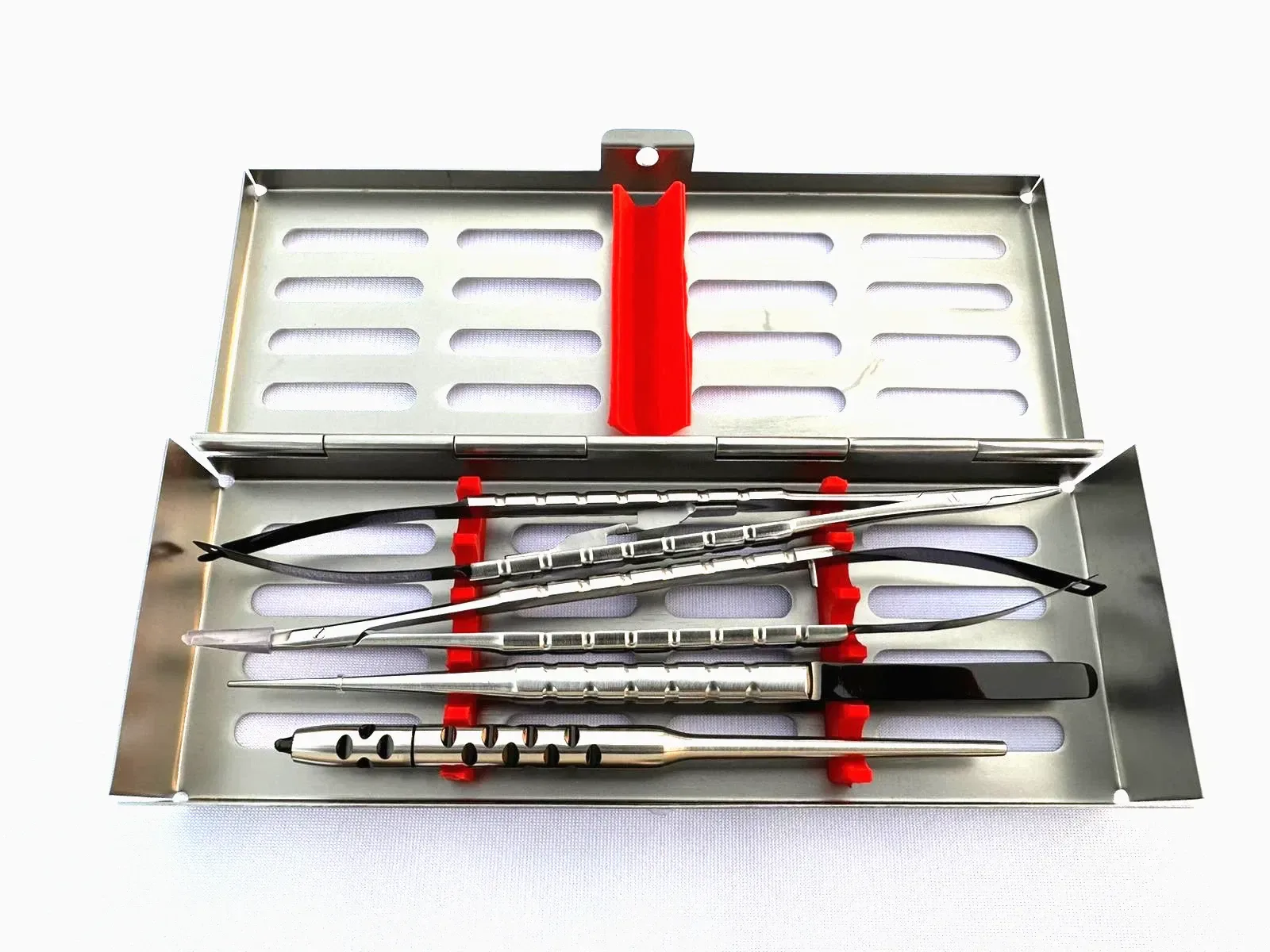
Dental Microsurgery Instrument Set, 4 Pieces
Four-piece dental microsurgery set with a spring-action needle holder, spring-action scissors, fine tweezers and a round scalpel handle, supplied in a metal cassette.
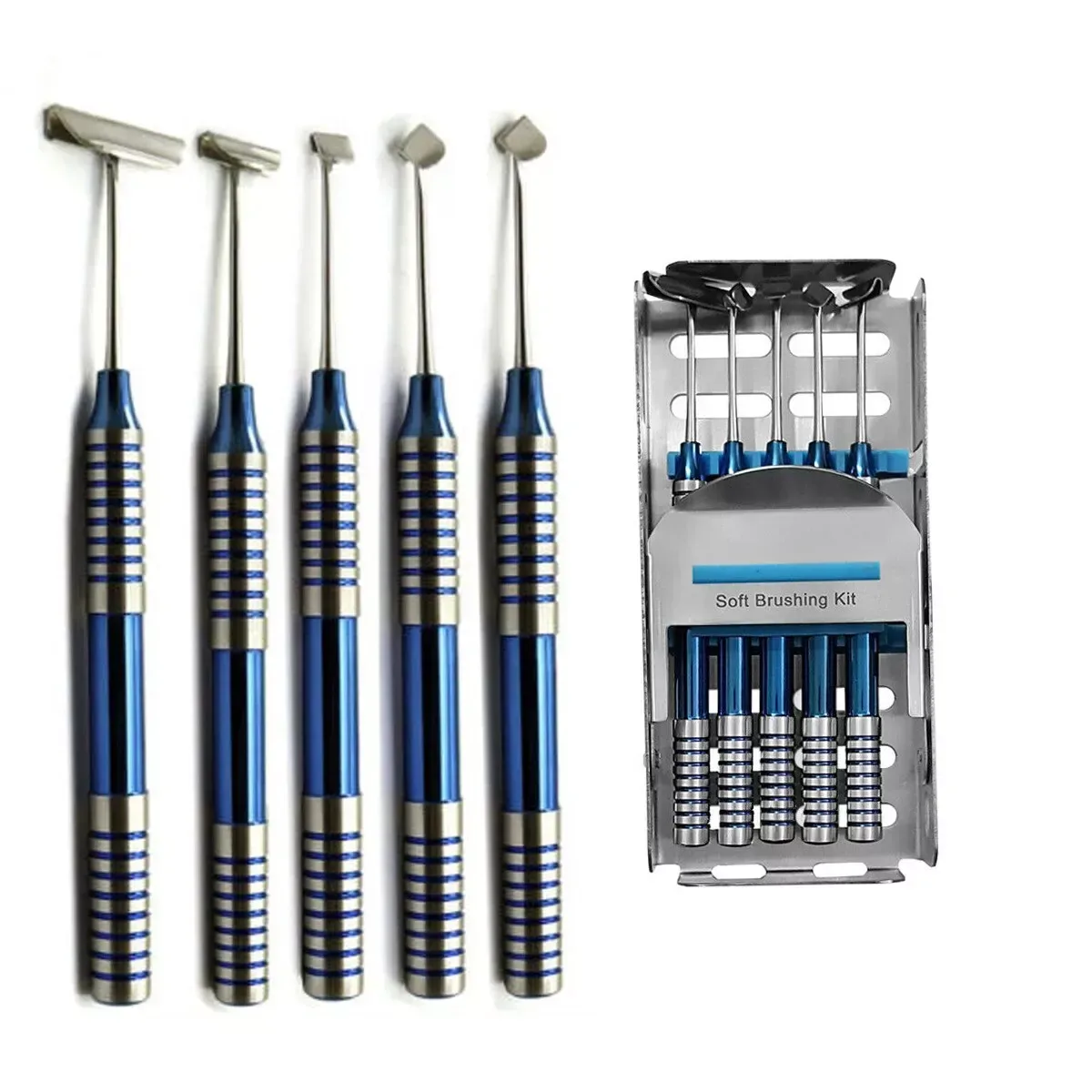
Implant Soft Brushing Instrument Kit
A five-instrument soft brushing kit for professional soft-tissue work in implant and periodontal surgery. One each of the large, medium, angulated straight, angulated left and angulated right patterns, in a blue titanium-coated finish, with a separate five-position cassette.
Implant and Periodontal Microsurgery Kits Selection Summary
| Specification | Details |
|---|---|
| Microsurgery set (4 pieces) | Spring-action needle holder, spring-action scissors, fine tweezers and a round scalpel handle, with a metal cassette that is not counted among the four |
| Not included in the microsurgery set | Scalpel blades, needles and sutures |
| Soft brushing kit (5 instruments) | Large, medium, angulated straight, angulated left and angulated right, one of each; manual instruments with metal working ends; blue titanium-coated finish |
| Soft brushing kit container | One five-position cassette, separate from the five-instrument count |
| Order unit | The complete kit: four instruments plus cassette, or five instruments plus cassette (brushing kit SKU DIS-IMP-BRUSH-5PC) |
Other Dental Implant Instruments Subcategories
Implant Drill Kits
An eight-drill surgical kit (2.0 to 5.2 mm, depth-marked) and conical drill and stopper kits in 25 to 55 pieces. Compare drills, s...
View SubcategoryGuided Implant Surgery Kits
Implant positioning kits with a 2.0 mm pilot drill and guides from 6.0 to 12.0 mm, plus a 15-piece option with 4 and 4.5 mm tissue...
View SubcategoryBone Expansion & Osteotome Kits
Screw-type bone expander kits (2.6–4.3 mm), a five-piece offset concave osteotome set (2.8–4.8 mm) and a nine-piece chisel and mal...
View SubcategoryBone Grafting & GBR Kits
A four-drill bone collector set (3.4, 4.0, 4.2, 5.2 mm) with metal holder, and GBR bone tack kits with titanium tacks in 2.5 and 3...
View SubcategoryImplant and Periodontal Microsurgery Kits FAQ
Does the microsurgery set contain four tools or five?
Four complete instruments: a spring-action needle holder, spring-action scissors, fine tweezers and a round scalpel handle. The metal cassette holds them and is not counted, so the set is four instruments plus a cassette. Scalpel blades, needles and sutures are not included. The soft brushing kit is a different product with five instruments.
Is the five-position cassette counted among the soft brushing instruments?
No. The kit is five manual instruments, one each of large, medium, angulated straight, angulated left and angulated right, and a separate five-position cassette that gives each pattern its own place. Quotations are for the complete kit, the five instruments plus the cassette.
Does the blue titanium-coated finish mean the soft brushing instruments are titanium?
No. Blue titanium-coated describes the finish on the metal working ends. It does not state the material of the instrument body, so ask for the material declaration with your quotation if you need it.
Is a soft brushing instrument a bristle brush?
No. Each is a manual hand instrument with a metal working end for soft-tissue and periosteal work in implant and periodontal surgery. It is not a bristle brush, an oral-hygiene brush or a powered implant-cleaning brush.
Does an implant-microsurgery kit describe the same assortment as a soft-tissue brushing kit?
No. Treat them as separately defined assortments. Compare the actual member list and working-end identities for the kit you need instead of combining them under a general soft-tissue title, and give fine scissors, forceps, holders and other instruments their own references and quantities wherever they appear in the schedule.
Which details identify a fine needle-holder configuration?
Compare the jaw profile and dimensions, straight or angled form, documented gripping surface, and handle or closure design. Keep those fields with the full reference. A microsurgery designation or slender handle alone does not establish the jaw size, gripping configuration or the same instrument as an existing holder.
How do spring-handle and ring-handle instruments compare for ordering?
They describe different handle arrangements and should be kept with the selected working-end reference. Also record the documented closure or lock configuration rather than deriving it from the general handle name. For a matched replacement, compare the entire instrument configuration, including jaws or blades and the handle arrangement.
What should I check when replacing fine scissors or tissue forceps from a kit?
Identify the exact member reference and compare its tip shape, working dimensions, angulation and documented gripping or cutting features. Include clear working-end views when markings are incomplete. The kit name and overall length help locate the instrument, but they do not establish a matching fine-tip configuration.
How should the contents of two microsurgery kits be compared?
Use a member-by-member schedule naming the forceps, scissors, needle holders and other complete instruments, with references and quantities. Check tip configurations and handle designs for each member, then list the container separately. A matching kit title or total count does not establish the same fine-instrument assortment.
Need Implant Microsurgery Kits in Bulk?
Send your instrument list and quantities for manufacturer-direct pricing, custom branding, or mixed-category quotes.