
Dental Implant Drill Kits
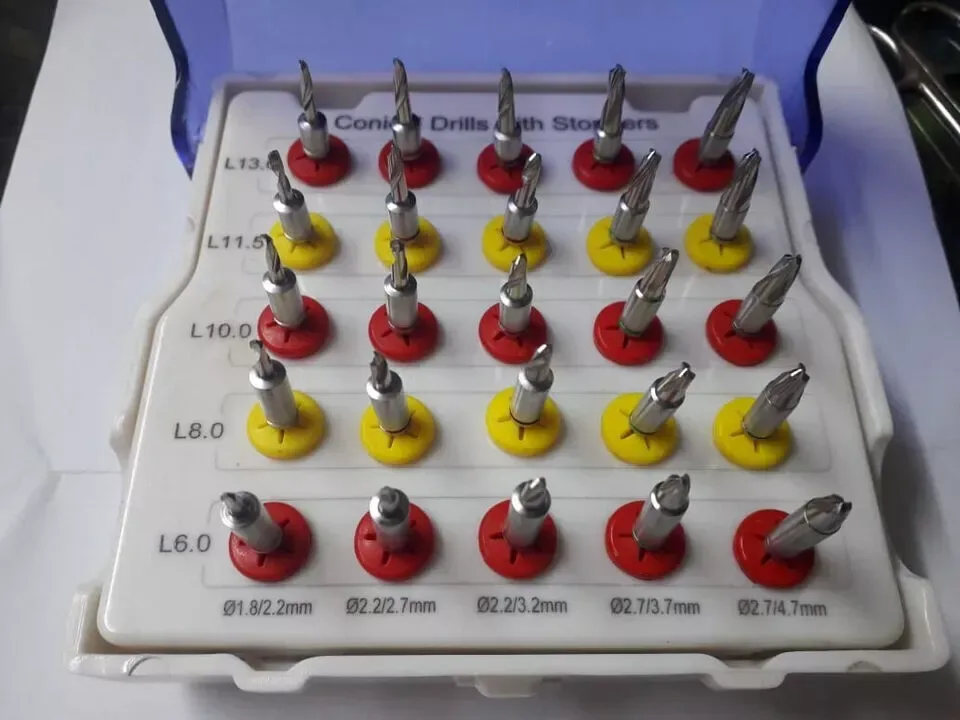
Conical Implant Drill & Stopper Kits
Conical implant drill kits with depth stoppers, organised in a labelled case. Choose from 25 to 55-piece sizes; we itemise every drill and stopper in your quotation.
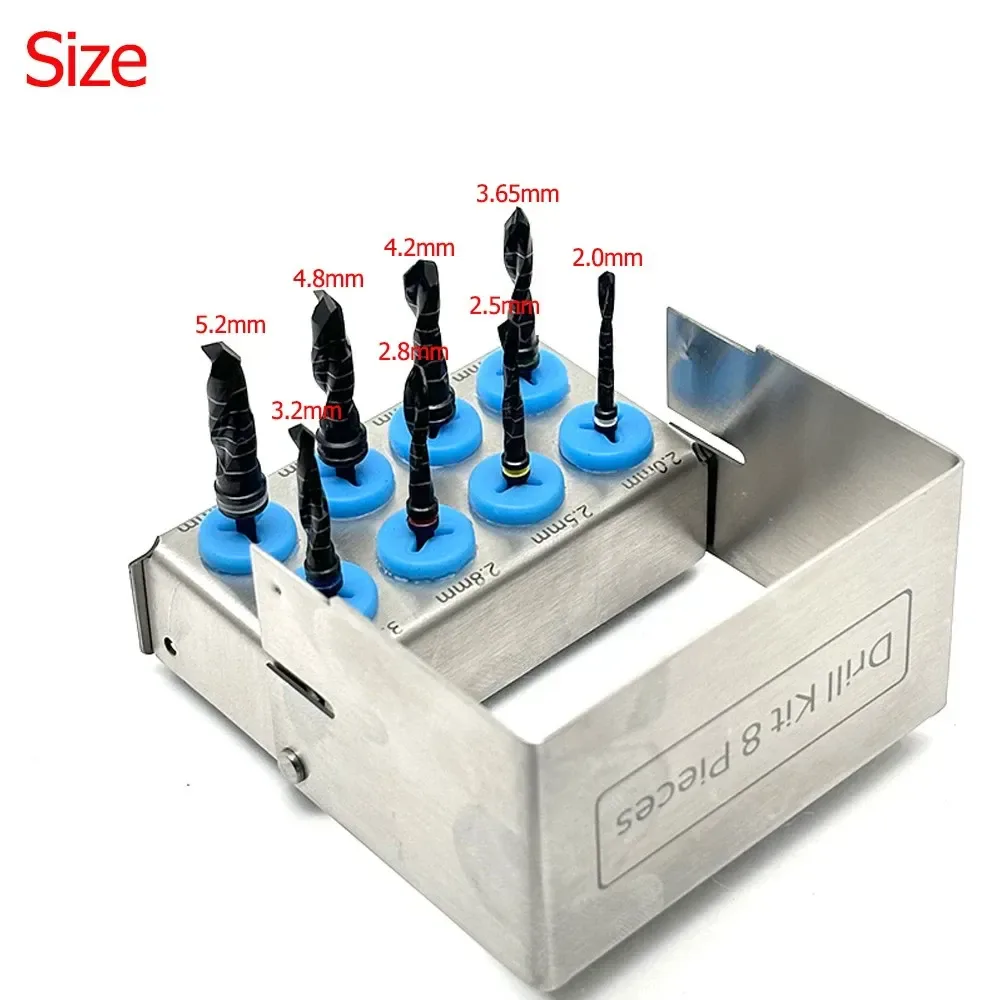
Dental Implant Surgical Drill Kits
Implant surgical drill kit with eight depth-marked drills from 2.0 to 5.2 mm, held in a diameter-labelled metal holder. Standard and coated kits are also available.
Dental Implant Drill Kits Selection Summary
| Specification | Details |
|---|---|
| Surgical drill kit | 8 depth-marked drills, black finish: 2.0, 2.5, 2.8, 3.2, 3.65, 4.2, 4.8 and 5.2 mm; diameter-labelled metal holder, not counted among the eight |
| Other surgical options | Standard surgical drill kit; coated surgical drill kit; single replacement drills quoted by kit and diameter |
| Conical drill and stopper kits | 25, 30, 35, 43, 50 and 55 pieces; conical drills and depth stoppers in a labelled case; every drill, stopper and accessory itemised in your quotation |
| Guided option | The 43-piece kit is the guided drill kit |
| Replacement matching | Kit and drill reference, full diameter designation, defined length, shank or drive connection, and any stopper or sleeve interface |
Other Dental Implant Instruments Subcategories
Guided Implant Surgery Kits
Implant positioning kits with a 2.0 mm pilot drill and guides from 6.0 to 12.0 mm, plus a 15-piece option with 4 and 4.5 mm tissue...
View SubcategoryBone Expansion & Osteotome Kits
Screw-type bone expander kits (2.6–4.3 mm), a five-piece offset concave osteotome set (2.8–4.8 mm) and a nine-piece chisel and mal...
View SubcategoryBone Grafting & GBR Kits
A four-drill bone collector set (3.4, 4.0, 4.2, 5.2 mm) with metal holder, and GBR bone tack kits with titanium tacks in 2.5 and 3...
View SubcategoryImplant Prosthetic Instruments
A three-piece collet-style holder that grips an implant abutment outside the mouth while it is shaped in the laboratory. Not a dri...
View SubcategoryDental Implant Drill Kits FAQ
Is the holder one of the eight drills in the surgical drill kit?
No. The kit is eight depth-marked drills, at 2.0, 2.5, 2.8, 3.2, 3.65, 4.2, 4.8 and 5.2 mm, plus a metal holder labelled by diameter. The holder is not counted among the eight, so count eight drills and one holder.
Does the piece count of a conical kit tell me how many drills it has?
No. The 25 to 55 piece sizes count drills, depth stoppers and any accessories together, and contents differ between sizes, so the total is not a drill count. An itemised list of every drill, stopper and accessory is sent for the kit you choose, and the same total can represent different diameter and length coverage.
Which records help compare a standard drill assortment and a conical stopper-drill kit?
Compare the member schedule and drawings for the selected drills, stops and interfaces. Keep each full part reference and quantity with its dimension key. A paired-diameter label needs a drawing that identifies both measurement locations; an L label needs its defined measurement datum. Request those definitions with the actual kit specification before treating the labels as directly comparable dimensions.
What does a paired diameter label on a conical drill tell me?
A paired label identifies two nominal values, but the specification needs to state where each is measured. Keep the complete pair and exact part reference in a comparison, and use an axis-defined drawing when a physical match matters. The ordering of the two numbers does not, by itself, establish tip and body diameter.
Does an L label establish the clinical drilling depth?
No. An L label needs a defined measurement reference for the particular drill and stop assembly, and it should be kept separate from overall length, tip projection and any documented working-length value. Compare the manufacturer's key for the exact part; a nominal label alone does not establish a calibrated clinical depth.
How does a drill's nominal diameter differ from its depth markings?
The nominal diameter is the size of the drill, such as 2.0 to 5.2 mm in the surgical kit. Depth markings along the shaft are a separate reference, and what they are measured from has to be defined for the exact drill. Record diameter, depth marking, working length and overall length as separate fields so a replacement is compared on each.
Which details are needed for a replacement implant drill?
Record the kit and drill reference, complete diameter designation, defined length, shank or drive connection, and any matched stop component. Include the relevant specification or clear reference markings. Treat the drill and stop as a documented combination when applicable, so a similar-looking replacement is assessed against the actual system.
How should the contents of two drill kits be compared?
List each drill reference and quantity, then record stops, adapters, drivers and the container separately. This distinguishes the cutting-instrument assortment from accessories and storage. Compare that schedule with the requested configuration; the same overall piece count can represent different diameter and length coverage.
Need Implant Drill Kits in Bulk?
Send your instrument list and quantities for manufacturer-direct pricing, custom branding, or mixed-category quotes.