
Guided Implant Surgery and Positioning Kits
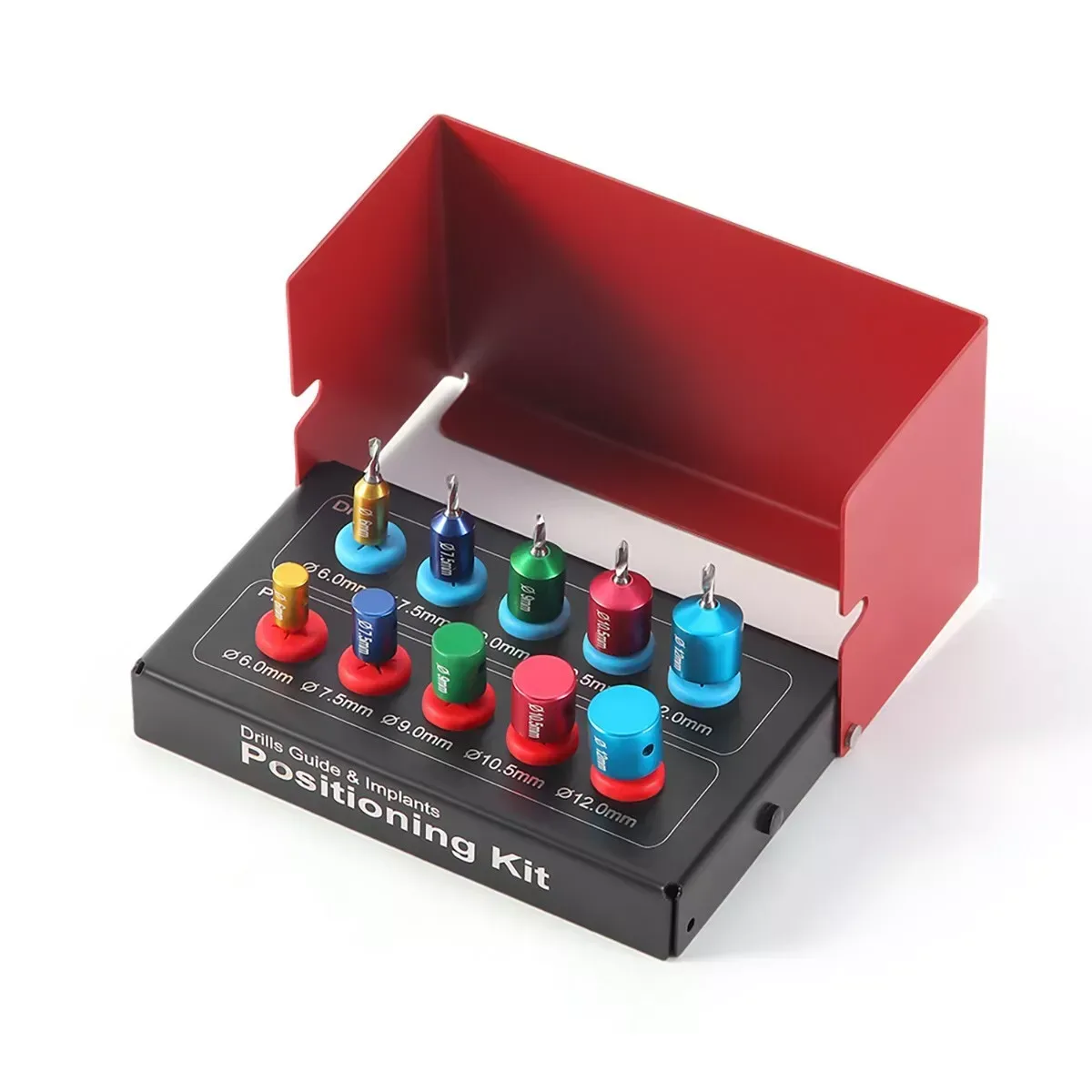
Implant Drill Guide Positioning Kits
Implant positioning kits with a 2.0 mm pilot drill and positioning guides from 6.0 to 12.0 mm, for marking implant sites and checking their position and spacing before drilling.
Guided Implant Surgery and Positioning Kits Selection Summary
| Specification | Details |
|---|---|
| Pilot drill | 2.0 mm |
| Positioning guides | 6.0, 7.5, 9.0, 10.5 and 12.0 mm; these are guide diameters, not drill sizes |
| Kit options | Pilot drill and positioning guide set; 15-piece implant guide kit |
| 15-piece kit adds | Tissue punches of 4 and 4.5 mm; stopper drills |
| Holder | Red holder (on the set shown) |
| Order unit | One kit; an itemised list is sent for the kit you choose |
Other Dental Implant Instruments Subcategories
Implant Drill Kits
An eight-drill surgical kit (2.0 to 5.2 mm, depth-marked) and conical drill and stopper kits in 25 to 55 pieces. Compare drills, s...
View SubcategoryBone Expansion & Osteotome Kits
Screw-type bone expander kits (2.6–4.3 mm), a five-piece offset concave osteotome set (2.8–4.8 mm) and a nine-piece chisel and mal...
View SubcategoryBone Grafting & GBR Kits
A four-drill bone collector set (3.4, 4.0, 4.2, 5.2 mm) with metal holder, and GBR bone tack kits with titanium tacks in 2.5 and 3...
View SubcategoryImplant Prosthetic Instruments
A three-piece collet-style holder that grips an implant abutment outside the mouth while it is shaped in the laboratory. Not a dri...
View SubcategoryGuided Implant Surgery and Positioning Kits FAQ
Is the positioning kit a full-sequence guided surgery kit?
No. The listed kit is a 2.0 mm pilot drill with five positioning guides of 6.0 to 12.0 mm, or a 15-piece kit that adds 4 and 4.5 mm tissue punches and stopper drills. It marks sites and checks position and spacing, and it is not itemised as matched guided drills and sleeves for a named system. Drills for the steps after marking are listed separately.
Are 6.0 to 12.0 mm the drill sizes in the positioning kit?
No. Those are the diameters of the five positioning guides: 6.0, 7.5, 9.0, 10.5 and 12.0 mm. The kit's pilot drill is 2.0 mm. Treat the guide values as a separate field from the pilot drill and from any sleeve bore, because none of them describes a drill sequence.
How do pilot-guided and fully guided kit requirements differ?
Compare which stages the system guides. One system, for example, describes a pilot setup with a guided first drill followed by a freehand kit, while a fully guided system identifies matched guided drills, sleeves, handles and transfer pieces for each stage. Use the exact system documentation and the itemized kit schedule to see which components a given kit includes.
What establishes compatibility between a guided drill and a sleeve?
Use the exact system and matching sleeve, drill and handle or key references, together with the documented dimensions and offset convention. These components form a specific assembly. A familiar nominal diameter or a universal-kit title does not establish the matching guidance interface or supported system.
Is the patient-specific surgical guide included in an instrument kit?
Not unless the offer says so. Treat the patient-specific guide and the reusable instrument assortment as separate purchasing lines unless the selected offer itemizes both. The guide is the planned guide component, while the kit is the instrument range used with a supported guided system, so the kit name alone does not show that a guide is supplied.
Can I compare guided-kit depth labels directly with unguided drill lengths?
First identify what each label measures: overall length, working length, guide offset or another defined reference. Guided assemblies involve the matched sleeve and guidance components as well as the drill. Use the exact system key for a dimensional comparison; equal printed numbers do not establish equal physical reference points.
Which interface details should I send for a system match?
Send the implant system or guided-surgery protocol you use, the guide or sleeve dimensions, the drill shank and any handle or key, the working length, and the stop or offset reference. Existing component references help most. We confirm how the kit fits with your system from those details.
What should an itemized guided-kit schedule include?
Record each drill, sleeve-related handle or key, driver, adapter and other identified accessory with its reference and quantity. List any case separately and distinguish instruments from patient-specific guide components. That schedule shows the offered coverage and replacement identities more clearly than a total piece count or a photograph of occupied case positions.
Need Guided Implant Surgery Kits in Bulk?
Send your instrument list and quantities for manufacturer-direct pricing, custom branding, or mixed-category quotes.