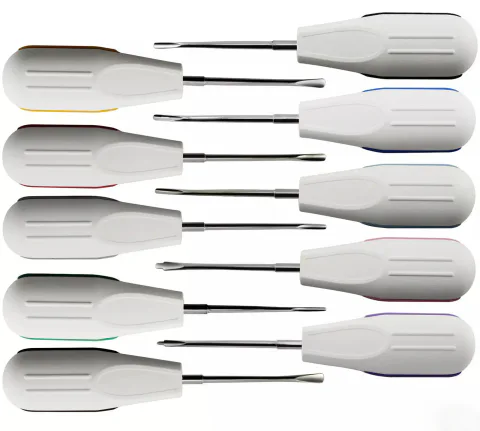
About Luxating Elevator Set
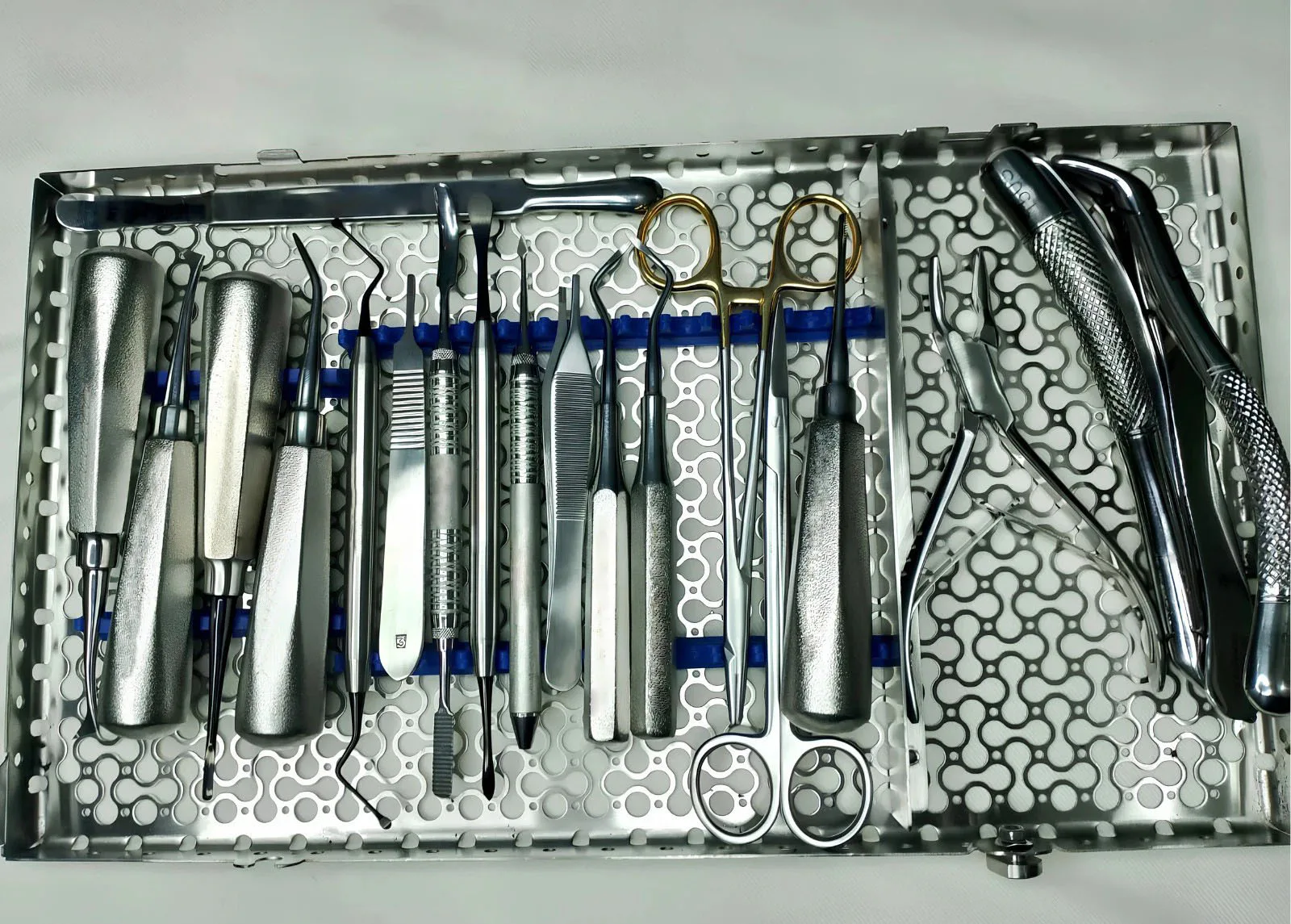
This set puts ten colour-coded luxating elevators in one assortment:
- four straight blades stepping from 2 mm to 5 mm
- curved 3 mm and 5 mm instruments
- a reverse bend and a contra bend, both at 3 mm
- two straight double-blade instruments
Each instrument has its own colour, so you can pick out the width and profile you want at a glance instead of reading it off the working end.
The ten instruments at a glance
- Straight, 2 mm — green
- Straight, 3 mm — gray
- Straight, 4 mm — red
- Straight, 5 mm — yellow
- Curved, 3 mm — black
- Curved, 5 mm — brown
- Reverse bend, 3 mm — dark blue
- Contra bend, 3 mm — light blue
- Straight double blade, 3/1.5 mm — purple
- Straight double blade, 5/3 mm — pink
Each double-blade instrument is identified by both of its blade widths but counts as one instrument, which brings the set to ten.
Thin working ends for the ligament space
A luxating elevator and a general extraction elevator share a name but do different work. The luxator's thin blade is made to enter the periodontal ligament space, while a heavier elevator is built for leverage. A luxating set therefore sits alongside your standard elevators rather than replacing them. The blade width and approach angle you choose determine where the working end seats.
Choosing width and profile
Start with width. The four straight blades give an even progression from the narrow 2 mm to 5 mm, so you can move up a size without leaving the straight profile. All straight blades approach in line with the handle.
Where a straight approach is awkward, the curved instruments angle the blade, in both 3 mm and 5 mm widths. The reverse-bend and contra-bend instruments each offset the 3 mm working end from the handle in a different way. Together with the curved 3 mm, the set gives you three angled approaches at the same width. The two straight double-blade instruments carry the paired width labels 3/1.5 mm and 5/3 mm.
Keeping the colour key with the set
The colour key is specific to this assortment rather than an industry-wide standard. Keep the colour key above with the set, particularly if you add luxators from other sources.
Construction and processing
All ten instruments are AISI 420 stainless steel with a polished finish. They are reusable and can be autoclaved at temperatures up to 134°C. Treat that figure as the upper limit, and run the set through the validated cycle given in the processing instructions supplied with it.
Requesting a quote
Give the set name or SKU DIS-DEN-0323 and the number of sets you need. If your enquiry concerns particular instruments, identify each one by profile, width and colour from the list. Add any packing or documentation requirements so they can be quoted with the order. Our Sialkot, Pakistan operation manufactures and supplies instruments for dental practices and distributors alike.
For general elevators in other patterns, see dental elevators, or request a quote for this set.