
How to Evaluate Dental Instrument Quality
Judge a dental instrument by what can be verified. That means its documented material and care instructions, the pattern and dimensions you ordered, its finish and movement on a sample, and records that identify the item. Price, appearance and a familiar name cannot stand in for those checks. This guide sets out the checks. It then applies them to four of our own configurations: a Gracey curette set, a five-slot cassette, Warwick James root elevators and a composite instrument set.

Read image details
- Image description
- A forceps working end illustrates alignment, movement and finish as visible quality checks.
- Image text
- Instrument quality ALIGNMENT MOVEMENT FINISH
What Makes a High-Quality Dental Instrument?
A well-made instrument matches its stated pattern and dimensions. It is made from a documented material with heat treatment suited to its use, has a clean finish, and moves as intended where it has a mechanism. Its maker also issues care and processing instructions for that product. Each of these points can be checked against evidence. None of them follows from brand, country or price alone.
Compare suppliers one attribute at a time: material and manufacture, finish and working ends, movement, and documentation. Where a sample cannot show an attribute, ask for the record that covers it.
Material and Manufacturing Signals
Ask for the steel grade, the hardness range in HRC where the maker states one, and the manufacturing route, such as forging. The route is one input among several. Alloy, heat treatment and design also affect strength and edge life. Those properties are shown by a test record that identifies the item, not by the name of the method.
Consistency within a batch is visible. Instruments supplied as the same pattern should match in figure, dimensions, weight and finish. Marked variation is a reason to ask how the batch was made and checked before you accept it.
Finish, Joints, and Working Ends
Look for an even surface without pits, cracks, burrs or discoloration, because surface defects can trap debris. On hinged instruments such as forceps, scissors and needle holders, the joint should move smoothly without play or grinding. The jaws should meet as the pattern intends. Some patterns are deliberately asymmetric, so compare against the pattern drawing or a reference instrument rather than assuming the two sides mirror each other.
Working ends carry the pattern. Check that each end matches the ordered figure, width and angle, and that cutting edges are continuous and free of nicks. On a double-ended instrument, check both ends. Misshaped or misaligned ends are difficult to correct after purchase.

Read image details
- Image description
- Forceps jaws and a graduated probe illustrate different checks for joints, fine ends and markings.
- Image text
- Inspect the details JAWS AND JOINT FINE END AND SCALE Alignment and movement Check the shape and legible markings.
Certifications and Documentation
Documentation should be evaluated against the exact legal manufacturer, site, product or activity scope, issuer, validity period, and destination-market requirement. A quality-management certificate, product conformity record, material report, and commercial export document answer different questions; one should not be presented as proof of another.
Samples are the most direct check before a large order. A sample shows geometry, finish, movement and markings. It cannot confirm alloy grade, coating composition or durability, which need documentation or a test record tied to the item or batch.

Read image details
- Image description
- An instrument sample and a document illustrate the difference between visible quality checks and supporting records.
- Image text
- The sample & the evidence INSPECT THE INSTRUMENT SUPPORTING RECORDS Shape, finish, movement Material, processing, scope
Gracey Reference Specifications
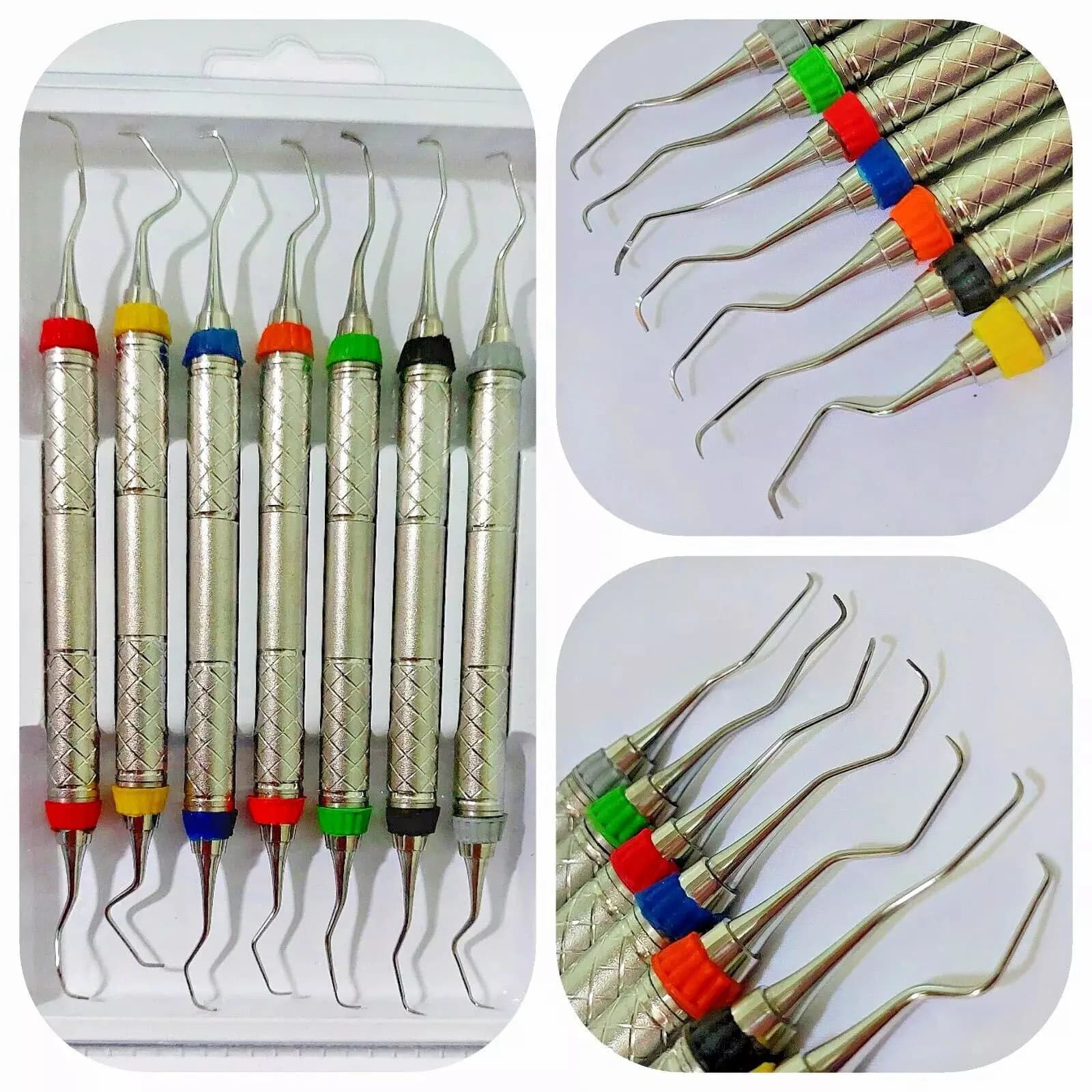
Our seven-piece Gracey curette set contains seven double-ended curettes in satin-finish stainless steel with colour-banded handles. A pair such as 11/12 is one instrument. The set is therefore defined by its figure pairs and the quantity of each.
Confirm the figure list and subtype in your quotation. If handle diameter or length matters, ask for those as well. Check evaluation samples of 1–3 pieces per pattern by their confirmed figures, not by band colour. Single curettes are available by figure pair and subtype.
Cassette Reference Specifications
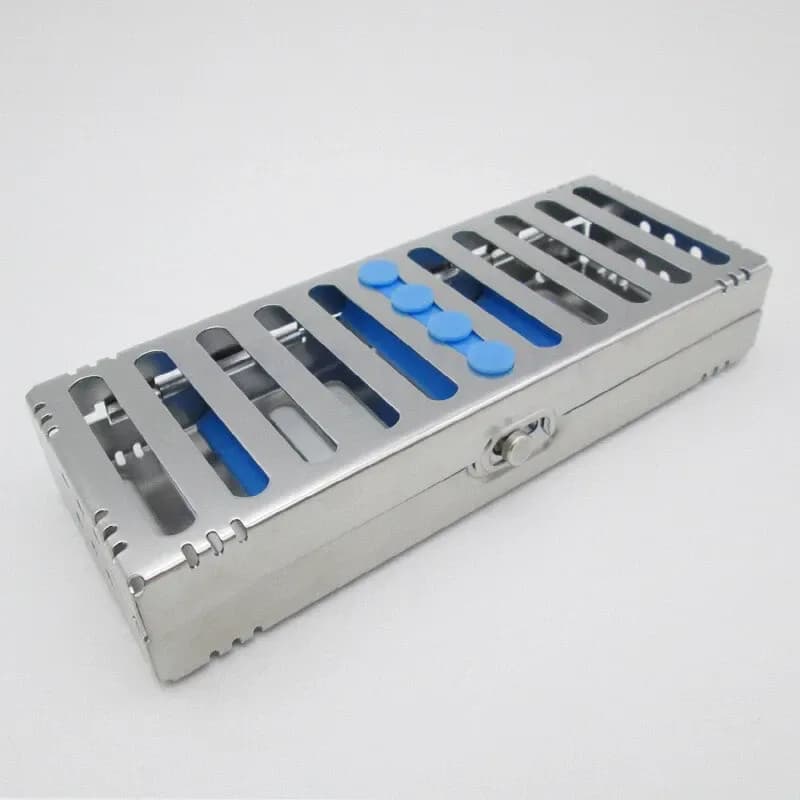
Our 5-slot instrument cassette is supplied as one empty cassette. It has a slotted metal body and lid, blue internal holders and closure hardware. The five positions set capacity, not instrument size. Ask for the usable inside length and width, the closed-lid height and the holder spacing. Compare them with your largest instrument.
The slotted lid is not a sterile barrier. Process the cassette only as the instructions for the cassette, its holders and your instruments allow.
Warwick James Reference Specifications
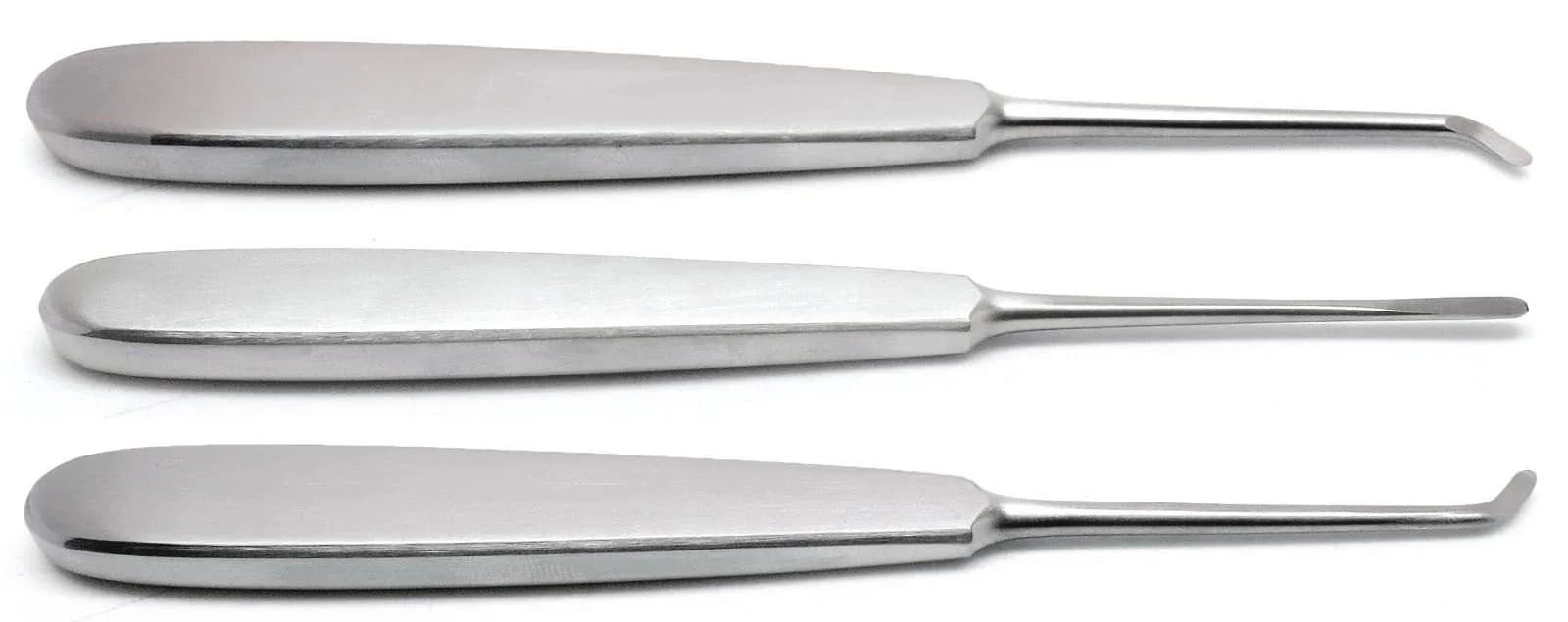
Our Warwick James root elevators are available in three forms, each with a flat, elongated handle and a rounded working end. The forms are DIS-CAT-0226 (Fig. 1, straight), DIS-CAT-0227 (Fig. 2L) and DIS-CAT-0228 (Fig. 3R, angled the opposite way). Figure numbers vary between catalogues, so quote the DIS-CAT reference.
End direction, overall length and working-end width are separate details. For a size match, measure your current elevator in millimetres. Ask for the same measurements on the reference you are quoted.
Composite Reference Specifications
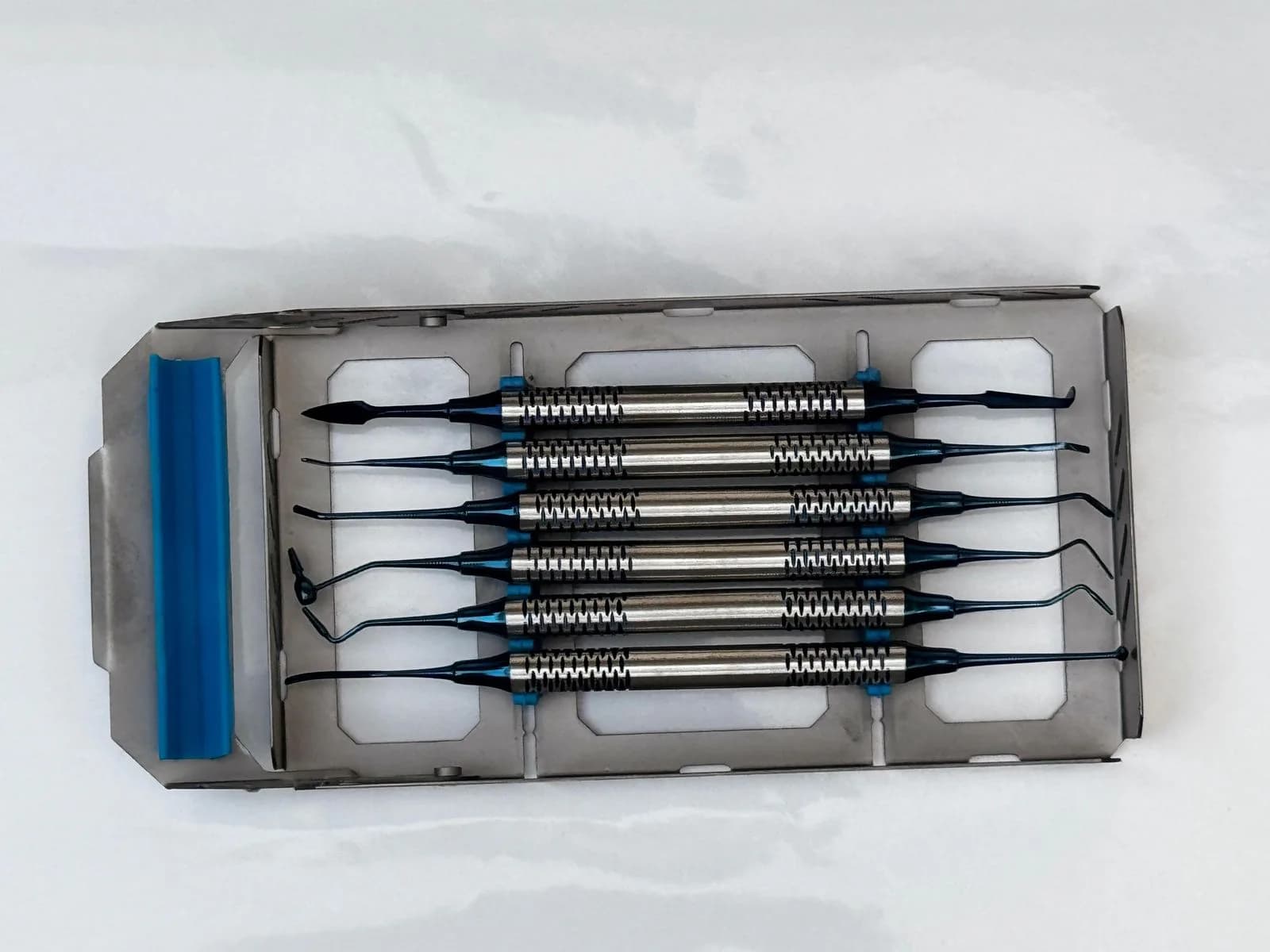
Our six-piece composite set has six double-ended instruments, twelve working ends and a matching metal cassette. Record both ends of each instrument when you reorder. Use the photo codes 1A/1B to 6A/6B to point to the end you want matched.
Colour does not identify a coating. Ask for the material, any coating and the care instructions in your quotation. If handling matters, have a qualified clinician assess an evaluation sample.
Our Product Configurations
The four DIS configurations covered above, showing what is supplied and how to order each one. The Gracey figure list and subtype are confirmed in your quotation. Ask for any dimensions or instructions you need, and check what the quotation states before you approve.
| Product | What is supplied | Visible construction | How to order |
|---|---|---|---|
| Gracey Curette Set, 7 pieces | 7 double-ended Gracey curettes; figure pairs, quantity of each and subtype confirmed in quotation | Satin stainless steel; colour-banded handles; one cutting edge per working end | Full set, or single curettes by figure pair and subtype; samples of 1–3 pieces per pattern; cassette or pouch quoted separately |
| 5-Slot Instrument Cassette | 1 empty cassette with 5 holding positions; instruments not included | Slotted metal body and lid; blue internal holders; closure hardware | By number of cassettes; ask for inside size, closed-lid height and holder spacing |
| Warwick James Root Elevators | The reference(s) you order, in the quantity stated. Available forms: DIS-CAT-0226 (Fig. 1, straight), DIS-CAT-0227 (Fig. 2L, angled), DIS-CAT-0228 (Fig. 3R, opposite angle) | Flat, elongated handles; rounded working ends | By reference and quantity; order 0227 and 0228 together for both angled directions |
| Composite Instrument Set, 6 pieces | 6 double-ended composite instruments (12 working ends) and 1 matching metal cassette | Dark working ends; blue handle accents | By number of sets; evaluation samples available; photo codes 1A/1B to 6A/6B for matching |
What Can Be Confirmed Before You Order
We hold ISO 9001:2015 quality management certification. Request the certificate and its covered organization, site, scope and validity details before ordering. This management-system certification is not a blanket product or destination-market approval.
Sialkot production workflow
Material selection, forming, heat treatment where required, grinding, finishing, inspection, marking, and export packing.
Material02Grade confirmed by SKU
Material and applicable steel grade are confirmed against the quoted pattern instead of applying one grade to every instrument family.
MOQ03Order-type minimums
Samples: 1-3 pieces per pattern; standard product orders: confirmed with your quote; mixed wholesale: 25 instruments (mixed patterns); OEM: 25 pieces per pattern.
Packaging04Protective and branded options
Individual pouches, procedure sets, cassettes, protective bulk cartons, product labels, and approved private-label packaging.
Export05Documented dispatch
Commercial invoice, packing list, protective outer packaging, and courier or freight tracking appropriate to the order.
Comparing an Offered Sample With the Instrument You Use Now
When you are replacing an instrument already in use, compare evaluation samples with that instrument one attribute at a time instead of judging the overall impression. Samples are available at 1–3 pieces per pattern, and the cost is confirmed by quote.
- Pattern: the full name or figure, both working ends, and left or right where that applies.
- Dimensions: the measurements that matter to your use. Measure both instruments the same way and note the method.
- Material and finish: what each item's documentation states. Record this separately from how the surface looks.
- Handle: type, profile, length, texture and any colour coding.
- Movement and fit: joint action, tip closure or spring tension on hinged and spring instruments.
Keep what you observed separate from what has been tested. A matching appearance, weight or feel is an observation. Edge retention and behaviour after repeated reprocessing are tested properties, and they need a test record that identifies the item. We do not currently publish hardness, torsion, corrosion or fatigue results. A favourable sample review should therefore be recorded as a review only, not as evidence that the two instruments are equivalent. If your approval depends on a tested property, state the test and acceptance criteria in your quote request. Our evidence center explains what documentation can be requested.
The blank comparison record in our review and stock worksheet keeps observed, measured and documented findings in separate columns.
How to Evaluate Dental Instrument Quality FAQ
Does an ISO 9001 certificate establish the steel grade of an individual instrument?
No. ISO 9001 covers an organization's quality management system and process controls, not the material of one instrument. A steel statement is separate evidence that has to identify the product or batch, so read the certificate's issuer, organization and scope alongside the product documentation instead of using it in place of a material record.
Can a visual sample confirm an exact alloy grade or coating composition?
No. A sample lets you judge visible geometry, finish, movement and markings, and evaluation samples of 1-3 pieces per pattern are available for that check. Exact alloy or coating composition needs documentation or an appropriate test tied to the sample or batch, so keep the two checks separate: a good finish and a familiar color are observations, not a material certificate.
What should be compared before deciding that one quotation is cheaper?
Compare the same complete configuration: pattern, working ends, handle, specified material or coating, quantities and separately listed accessories. Then review the actual order terms. Two offers for a named pattern can cover different instruments; a price comparison becomes meaningful once the products and scope are aligned.
Why keep the approved sample reference after the first order?
It provides a concrete comparison for later supply. Record the sample's complete reference, working-end dimensions or drawing revision, handle and finish, then check repeat units against those agreed attributes. Keep photographs and relevant documentation together so an accepted change is visible instead of being mistaken for the original specification.
Should every instrument be checked using the same quality checklist?
Partly. Use shared checks for identity, finish and documentation, then add checks for the product's mechanism: a graduated probe needs the specified scale, a hinged instrument needs its intended jaw relationship and movement, and a double-ended instrument needs both ends verified. A generic checklist can miss the feature that distinguishes the ordered pattern.
If a sample looks and feels the same as my current instrument, will it last as long?
Not necessarily, and a sample review cannot show it. Appearance, weight and handling are observations. How an edge holds up, or how the instrument behaves after repeated reprocessing, depends on properties that need a test record identifying the item. We do not currently publish hardness, torsion, corrosion or fatigue results. Record the sample review as a review. If durability is a condition of your order, state the test and acceptance criteria in your quote request.
Related Guides
Dental Instrument Materials and Stainless Steel Grades
Dental instrument materials explained: martensitic and austenitic stainless steel grades (AISI 410, 420, 420J2, 440), Rockwell hardness, corrosion resistance, forging, and passivation.
Read GuideComplete Guide to Dental Instruments
Learn the main types of dental instruments, how they are used, what materials matter, and how to choose reliable tools for clinical workflows.
Read GuideChoosing Dental Extraction Forceps
How to choose dental extraction forceps by arch, tooth position, beak shape, root anatomy, handle style, and clinical workflow.
Read GuideReady to Compare Instruments?
Browse our categories or send your instrument list for manufacturer-direct pricing.